Twenty minutes is enough
Illustrative example. Not a real job or customer.
Illustrative example. In a 1990s two-story home in Englewood, a parent starts filling the upstairs tub, gets pulled into a phone call downstairs, and forgets. About twenty minutes later water is coming through the living room ceiling around the light fixture and dripping onto the rug.
- One parent runs upstairs and turns off the tub; the other switches off the living room light at the wall and then at the breaker.
- They pull the rug and the coffee table out of the drip zone and put a bucket under the fixture without standing directly under the wet ceiling.
- They soak up the bathroom floor with towels and check the hallway carpet, which is wet near the bathroom door.
- They photograph the bathroom floor, the ceiling below, the light fixture and the rug.
- The next day a restoration company finds wet subfloor under the vinyl, wet insulation in the joist bay, and a wet section of ceiling drywall about the size of a door.
The light fixture was replaced by an electrician, the wet ceiling section was cut out and the joist bay dried, and the vinyl in the bathroom was lifted so the subfloor could dry. The hallway carpet dried in place.
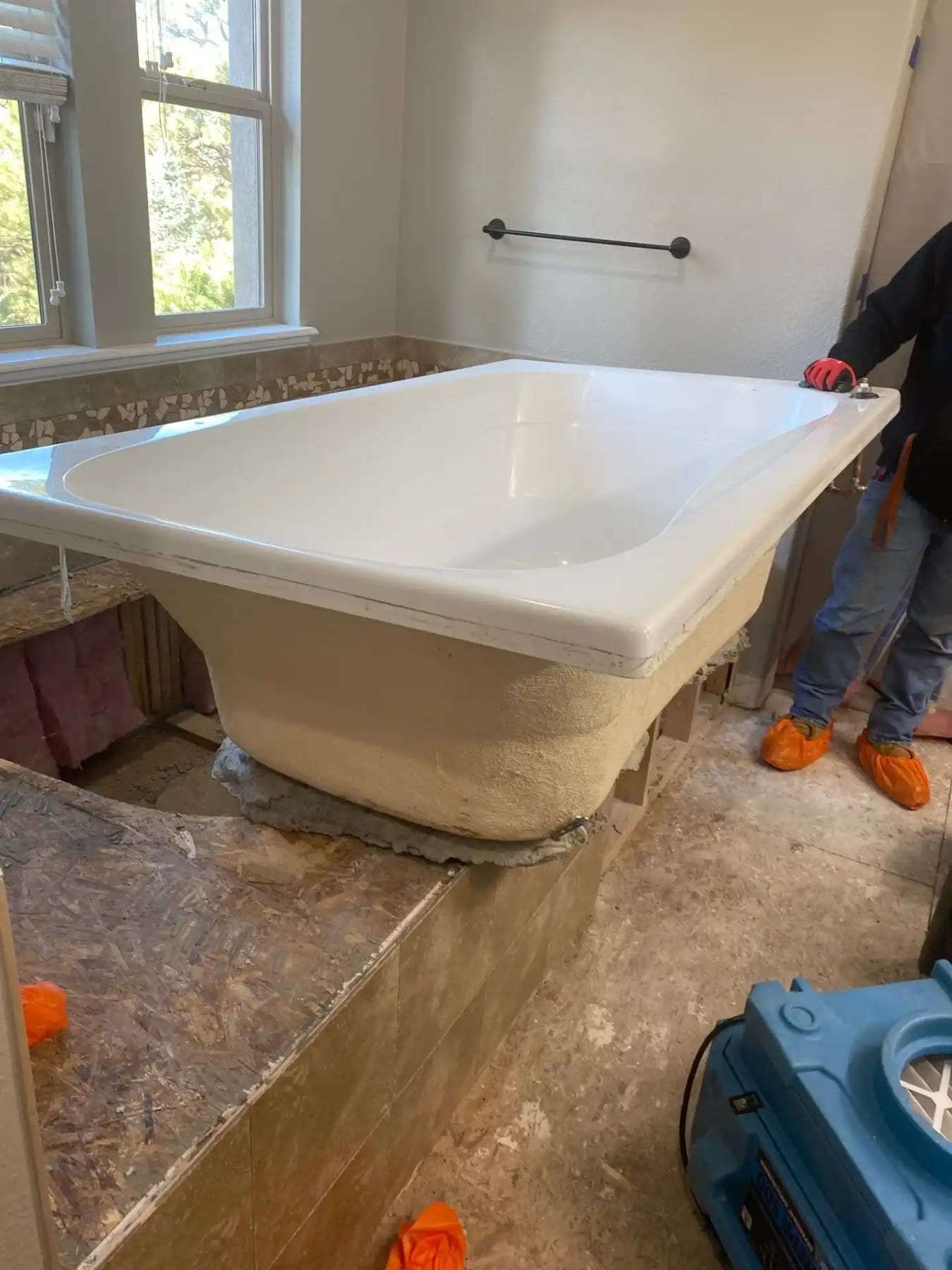
Bathtub with its surround removed and an air mover drying the subfloor. Example of the work involved; the photo does not show a specific property or a job for this site.
What helped and what would have hurt
| Helped | Would have hurt |
|---|---|
| Turning off the light at the switch and the breaker | Turning the light back on to see better |
| Moving furniture without standing under the drip | Assuming the ceiling would dry on its own |
| Photos taken that evening, before cleanup | Repainting the stain within a week |
| Calling someone with moisture meters the next day | Leaving wet vinyl down over the subfloor |
| Letting an electrician check the fixture before use | Waiting for a musty smell before acting |
Why water travels so far
Bathroom floors are not watertight. Water runs to the edges of the tub and the toilet flange, through gaps around pipes, and between vinyl and subfloor. Below that, it follows joists and pools on the back of the ceiling until it finds a hole, which is often a light fixture or a smoke detector box.
That is why a ceiling stain can look small while the space above it is soaked. Insulation in the joist bay holds water like a sponge, and plywood or OSB subfloor can swell and delaminate if it stays wet. Measuring with a moisture meter, not just touching the surface, tells you what actually needs to come out.
Questions to ask the next day
- How far did the water travel, measured, not guessed?
- Is anything under the bathroom floor covering still wet?
- Was the light fixture or wiring exposed to water, and has an electrician looked at it?
- What will be dried in place and what will be removed, and why?
- Does your policy treat an overflow differently from a pipe break?
Common questions
Can I use the light once it stops dripping?
Not until an electrician has checked it. Water inside a fixture or junction box can cause shorts or shocks even after it looks dry.
General information for Englewood, not a quote or professional advice. In an emergency, call 911.